Loading...
Searching...
No Matches
graphdom::graph< VertexType > Class Template Referenceabstract
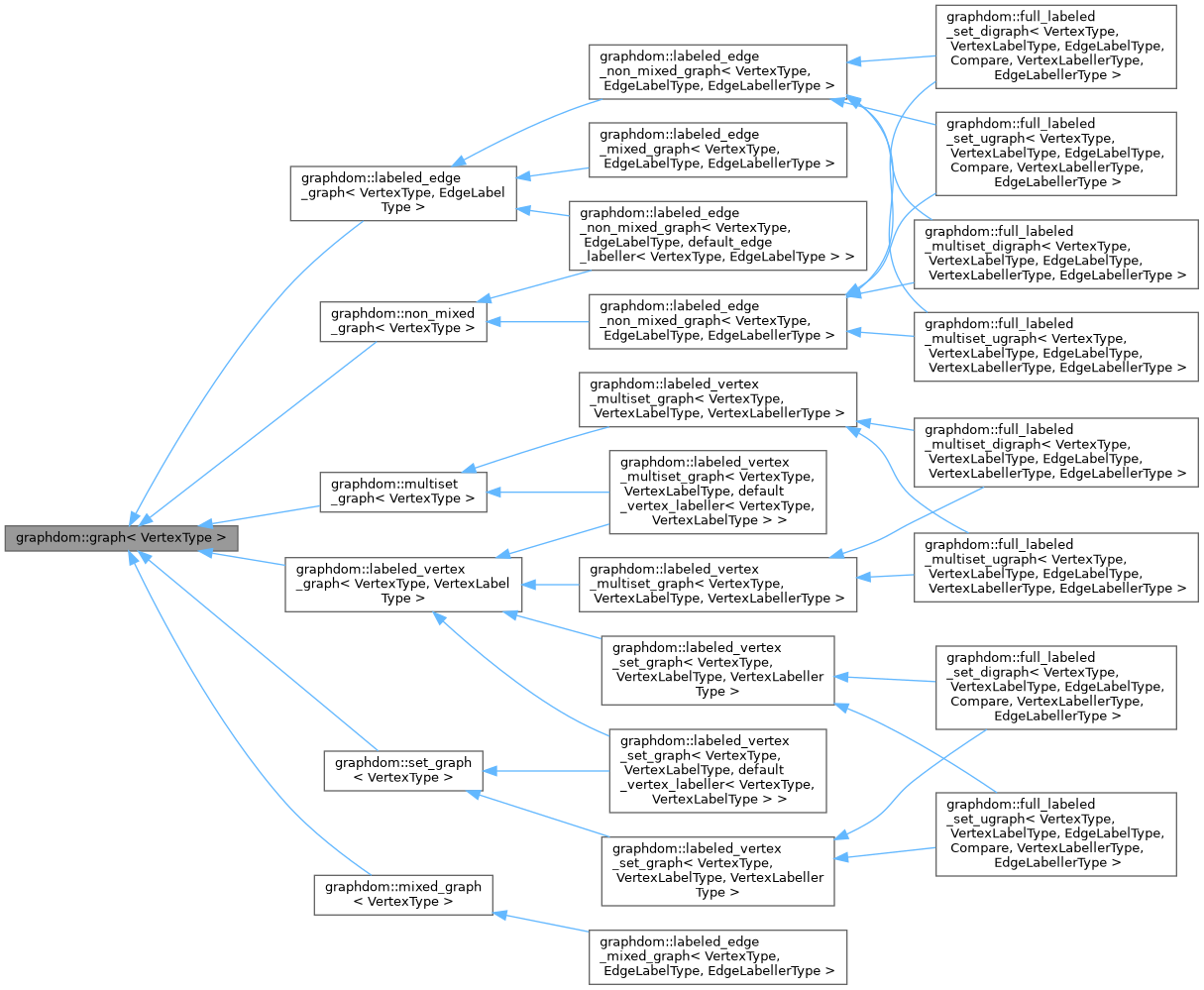
Every graph created using this library is an instance of a concrete class publicly derived, directly or indirectly, from this polymorphic template class. More...
#include <graph.h>
Inheritance diagram for graphdom::graph< VertexType >:
Classes | |
| class | adj_list |
| Every valid instance of this class is a "container-like and non-owning" handle to a subset of the set of all out-edges of a vertex. More... | |
| class | const_adj_list |
| Every valid instance of this class is a "container-like and non-owning" handle to a subset of the set of all out-edges of a vertex. A valid instance adj of this class cannot create objects that allow modification of the graph to which the vertex associated with adj belongs without a non-constant reference to that graph. More... | |
| class | vertex_const_handle |
| Every valid instance of this class can be used to identify a specific vertex of a graph and to access its core by reference or pointer. A valid instance hndl of this class cannot create objects that allow modification of the graph to which the vertex identified by hndl belongs without a non-const reference to that graph. More... | |
| class | vertex_handle |
| Every valid instance of this class can be used to identify a specific vertex of a graph and to access its core by reference or pointer. More... | |
Public Member Functions | |
| virtual | ~graph ()=default |
| To be polymorphic, this class has a virtual destructor. | |
| virtual std::size_t | order () const =0 |
| Returns the order of *this, i.e. the number of vertices inside the graph. | |
| virtual void | erase_vertex (const vertex_const_handle &vertex)=0 |
Removes the vertex identified by vertex. | |
| virtual adj_list_iterator | erase_edge (const adj_list_const_iterator &)=0 |
Detailed Description
template<typename VertexType>
class graphdom::graph< VertexType >
class graphdom::graph< VertexType >
Every graph created using this library is an instance of a concrete class publicly derived, directly or indirectly, from this polymorphic template class.
Creating an object of a user-defined class derived, directly or indirectly, from this one will cause undefined behavior.
Every graph created with this library can be considered equivalent, with the necessary precautions listed below, to a graph consistent with the definition found on the "Mathematical Introduction" page.
Referring to the symbols used in that definition and considering a non-const reference g to this class, the "precautions" are as follows:
- \( V_\text{type} \) is the set of all possible instances of
VertexType; - The set \( V \) must be considered dynamic, to allow, obviously, the insertion and erasion of vertices from g;
- If c is a reference to the core of a vertex \( v \) in g, then \( v = ( \) c \( , \) &c \( ) \);
- g stores only the cores of its vertices; (this is a direct consequence of the previous point)
- The sets \( E_\text{di} \) and \( E_\text{un} \) must be considered dynamic to allow, obviously, the insertion and erasion of edges from g;
- If g is a labeled-vertex graph and \( v \) is a vertex in g, then \( l_V(v) \) must be considered dynamic to allow, obviously, the label of \( v \) to be changed;
- If g is a labeled-edge graph and \( y \) is an edge in g, then \( l_E(y) \) must be considered dynamic to allow, obviously, the label of \( y \) to be changed;
Member Function Documentation
◆ erase_vertex()
template<typename VertexType>
|
pure virtual |
Removes the vertex identified by vertex.
After erasion, vertex and all its equivalents are invalidated.
- Parameters
-
vertex An object that identifies the vertex to be erased.
vertexmust be valid and must identify a vertex belonging to *this, otherwise the erasion will cause undefined behavior.
◆ order()
template<typename VertexType>
|
nodiscardpure virtual |
Returns the order of *this, i.e. the number of vertices inside the graph.
- Returns
- The number of vertices inside *this.
Implemented in graphdom::full_labeled_multiset_digraph< VertexType, VertexLabelType, EdgeLabelType, VertexLabellerType, EdgeLabellerType >, graphdom::full_labeled_multiset_ugraph< VertexType, VertexLabelType, EdgeLabelType, VertexLabellerType, EdgeLabellerType >, graphdom::full_labeled_set_digraph< VertexType, VertexLabelType, EdgeLabelType, Compare, VertexLabellerType, EdgeLabellerType >, and graphdom::full_labeled_set_ugraph< VertexType, VertexLabelType, EdgeLabelType, Compare, VertexLabellerType, EdgeLabellerType >.
The documentation for this class was generated from the following file:
- include/graphdom/graph.h